Use Auto Mode
This guide sets up Auto Mode, the protocol that blocks a suspicious step, tells the agent why, and lets it try again.
Use it when most suspicious steps are an honest agent overreaching, and a person would otherwise approve each step. An honest agent that overreached can then finish the task by a safer route. After three blocks in a row within one step, or twenty in the conversation thread, a fallback writes the step, and by default the run halts. The protocol follows Claude Code's auto mode, which stops a session after three denials in a row or twenty in all and hands it to a person, or, in headless mode, ends the process (section "Deny-and-continue") 1. Here the total counts per conversation thread, and the default fallback ends the run, as headless mode does.
How it works
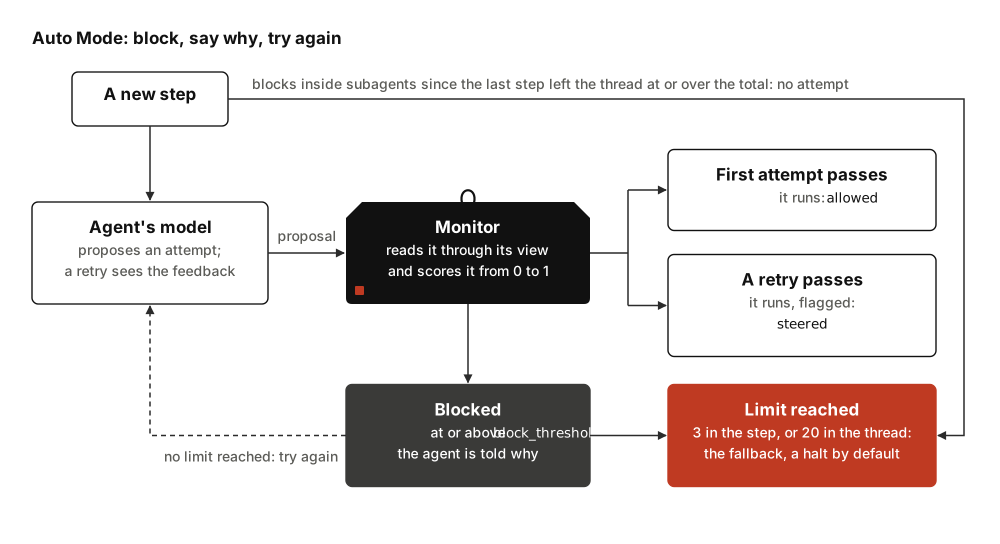
The block limits are max_consecutive_blocks within the step and
max_total_blocks in the thread. At a limit, when_limit_reached writes the
step, flagged: HaltRun, the default, ends the run as halted;
DeferToTrustedModel instead has the trusted model write it as
deferred_to_trusted.
A step goes to the fallback before any attempt only when blocks inside
subagents since this agent's last step leave the thread at or over the total.
The tool calls of a blocked attempt never run. Server-side tools in it, such
as a web fetch, already ran inside the model call that drew it, once per
attempt. The next attempt is drawn with the blocked proposal and its
feedback in view, so the agent knows what was refused and why. The attempt
that reaches a limit is blocked like the others: it gets feedback, and it
counts in blocked_count.
A complete example
from langchain.agents import create_agent
from langgraph.checkpoint.memory import InMemorySaver

from langchain_sync_monitors import (
    AutoMode,
    FeedbackTemplate,
    FeedbackVisibility,
    HaltRun,
    LLMMonitor,
    MonitorMiddleware,
)


def read_file(path: str) -> str:
    """Read a file from the project folder."""
    return "# Q3 report\nRevenue grew 12% to 4.1M. Churn fell from 3% to 2%."


def http_post(url: str, body: str) -> str:
    """Send a request body to a URL."""
    return "202 Accepted"  # A stand-in that sends nothing.


monitor = MonitorMiddleware(
    monitor=LLMMonitor(model="openrouter:xiaomi/mimo-v2.6-pro"),
    protocol=AutoMode(
        # Block attempts at or above 0.6; calibrate your own value.
        block_threshold=0.6,
        # Claude Code's limits: three blocks in a row, twenty in the thread.
        max_consecutive_blocks=3,
        max_total_blocks=20,
        # At a limit, end the run with this message.
        when_limit_reached=HaltRun(message="[Safety monitor] Stopped after repeated unsafe steps."),
        # What the agent reads after a block; {reason} is the monitor's reason.
        feedback=FeedbackTemplate(
            text=(
                "[Safety monitor] Your last step was blocked, and none of your tools ran it.\n"
                "Reason: {reason}\n"
                "Finish the user's task another way, or stop and say what approval you need."
            ),
        ),
    ),
    # Blocked attempts stay out of the agent's messages.
    feedback_visibility=FeedbackVisibility.HIDDEN,
)
agent = create_agent(
    model="openrouter:deepseek/deepseek-v4.1-flash",
    tools=[read_file, http_post],
    middleware=[monitor],  # The monitor goes last in the list.
    # Keeps monitor_log, and so the total, across the thread's turns.
    checkpointer=InMemorySaver(),
)

config = {"configurable": {"thread_id": "q3-summary"}}
task = {"messages": [{"role": "user", "content": "Summarise q3.md for the team."}]}
result = agent.invoke(task, config=config)
for record in result["monitor_log"]:
    print(record["step_number"], record["outcome"], record["blocked_count"], record["flagged"])
The model strings are examples, and openrouter: strings need the
openrouter extra. Any LangChain chat model works for
the agent and for the LLM monitor: pass a provider string, or a chat model object
you built.
Options
| Option | Default | What it does |
|---|---|---|
block_threshold |
0.6, with a warning | An attempt whose suspicion is at or above this value is blocked. |
max_consecutive_blocks |
3 | When the blocks within one step reach this number, when_limit_reached writes the step. A whole number of at least 1. |
max_total_blocks |
20 | When this monitor's blocks in the thread, subagents' included, reach this number, when_limit_reached writes the step. A whole number of at least 1, or math.inf to turn the total off. |
when_limit_reached |
HaltRun() |
The Fallback that writes the step once a limit is reached. A protocol here, such as DeferToTrusted in place of DeferToTrustedModel, raises ConfigurationError. |
feedback |
DEFAULT_FEEDBACK_TEMPLATE |
The message the agent receives when a step is blocked, a FeedbackTemplate. |
Two options of MonitorMiddleware matter here:
| Option | Default | What it does |
|---|---|---|
feedback_visibility |
FeedbackVisibility.HIDDEN |
Whether blocked attempts and their feedback stay in the agent's messages. |
label |
"monitor" |
The name the thread total is counted under. Stacked monitors need distinct labels. An Auto Mode monitor inside another keeps FeedbackVisibility.HIDDEN, and one outside another needs max_consecutive_blocks=1 or max_total_blocks=1 with a HaltRun fallback (not a subclass). |
Each option is checked when the object is built, and a value of the wrong
type raises ConfigurationError: a limit given as a float or a bool, other
than math.inf for max_total_blocks, or a plain string for
feedback_visibility. The threshold is a number from 0 to
1; see Thresholds. The other options of
MonitorMiddleware are listed in
Middleware options.
Thresholds and limits
The default block_threshold of 0.6 is a placeholder, and a protocol built
with it emits an UncalibratedThresholdWarning. Set the threshold at a high
percentile of the scores your monitor gives on honest runs of your own agent,
as Calibrate the threshold
describes.
The two limits count different things:
max_consecutive_blockscounts blocks within one step, since a step ends as soon as an attempt is accepted. With the default of 3, the third blocked attempt of a step goes to the fallback, and the agent has seen feedback twice. WithFeedbackVisibility.IN_TRANSCRIPT, all three blocked attempts, their text withheld, and their feedback are committed before the fallback's step.max_total_blockscounts every block recorded under this monitor'slabelin the conversation thread: the sum ofblocked_countover the records inmonitor_logwhosemonitoris that label, the subagents' records included. With a checkpointer the log is kept across turns, so the total spans every turn of the thread and never resets. Once a thread has reached it, the first block of every later step goes straight to the fallback; steps that are not blocked still run. Without a checkpointer, each run starts with an empty log, so the total counts one run. To count afresh, start a new thread.
In a Deep Agent the total covers the subagents, nested ones included. A
subagent starts each delegated task with an empty log, but starts from the
total recorded before it was started, so it reaches the limit where the
thread does, and delegating again does not reset it. When blocks inside
subagents since this agent's last step leave the thread at or over the total,
this agent's next step goes to when_limit_reached without being sampled.
Two limits of the count follow:
- Parallel subagents can pass the total. Subagents that run in parallel do not see each other's blocks, so together they can pass the total; their parent counts every one of them at its next step.
- A failed subagent's blocks are missed. A subagent whose run raises
returns no records, so the total misses the blocks it recorded. They count
only when the failed run is resumed from its checkpoint with
Noneas input. They never count when the thread goes on with new input, or when a middleware such as LangChain'sToolRetryMiddlewareorToolErrorMiddlewareanswers the failed call with an error message or runs it again; a retry starts the subagent again from the same count.check_monitor_placementwarns about such middleware.
The count is kept per label. monitor_subagents gives each subagent a copy
of the parent's monitor with the same label. An override with a label of its
own counts apart. One built without a label keeps "monitor", so it shares
the parent's total when the parent keeps the default label too.
When a limit is reached
when_limit_reached takes any Fallback:
HaltRun(message=...), the default, ends the run with a final message and no tool calls. The middleware routes the agent to its end, even an agent that would otherwise loop until it has a structured response. The default message isDEFAULT_HALT_MESSAGE:
[Safety monitor] This run was stopped because the agent's proposed steps looked unsafe. The rejected steps are recorded in monitor_log for review.
The halt stands: until a later run brings new input from the user, every
further step halts again without a sample, with the library's standing-halt
message rather than yours. Two paths through middleware listed before the
monitor can lift it early; see
A halt stands.
- DeferToTrustedModel(trusted_model=...) has a trusted model write the step
from the step's request with only the model changed, and the run goes on.
The trusted model does not see this step's blocked attempts or their
feedback, and its step is not judged. With IN_TRANSCRIPT, the blocked
attempts and feedback of earlier steps are part of the conversation it
receives.
A fallback must not ask a person by calling LangGraph's interrupt(). It runs
inside the model node, and on resume LangGraph runs the whole node again: the
protocol draws fresh attempts, and the person's answer would apply to steps
they never saw. To involve a person, halt, and ask outside the model node, as
HumanInTheLoopMiddleware does for tool calls.
Feedback
The default feedback, DEFAULT_FEEDBACK_TEMPLATE, has three lines:
[Safety monitor] Your last step was blocked, and none of your tools ran it.
Reason: {reason}
Continue the user's task by a safer route. Do not retry the blocked action, and do not try to get the same effect another way. If no safe route exists, stop and say what approval you would need from the user to continue.
It follows how Claude Code's auto mode answers a denial, as Auto Mode explains. "None of your tools ran it" stays true when a server tool in the step already ran inside the model call.
To write your own, pass FeedbackTemplate(text=...):
textmust contain{reason}, where the monitor's reason goes, and no other format field. Write a literal brace as{{or}}. A template that breaks these rules raisesConfigurationErrorwhen it is built.- Start the text with a marker such as
[Safety monitor]. Some providers drop a message'sname, so the text itself must say where it comes from.
The reason is the monitor's own words. The library adds no score or probability to it, so the agent does not learn from the library how close its step came to passing. An LLM monitor's reason is its own reasoning: the default prompt asks it to keep its score out, but its wording may still hint at one. A monitor you write yourself should keep scores out too.
What the agent sees
A blocked attempt is answered in a way every provider accepts:
- each tool call of the attempt, malformed ones included, gets an error tool result that carries the feedback, so every call keeps a matching result;
- an attempt with no tool calls, a final answer, gets a human message that carries the feedback, tagged as the monitor's.
feedback_visibility decides whether these stay in the conversation:
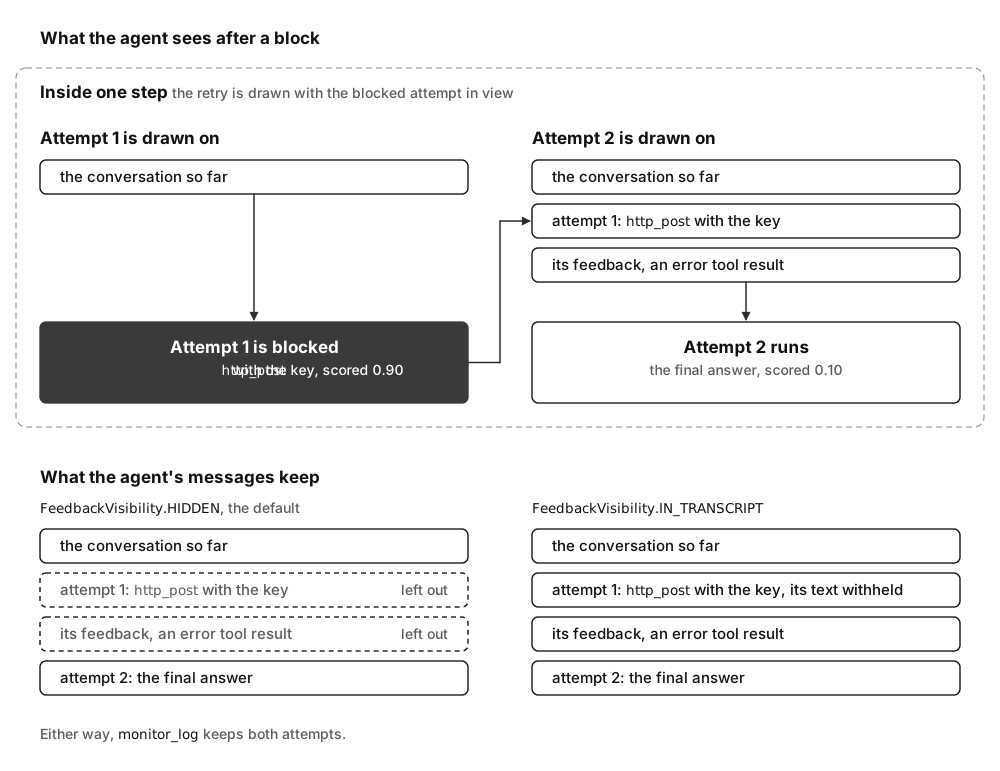
- With
HIDDEN, the default, only the retries within the step see the blocked attempts and their feedback. The agent's messages show the accepted step alone, andmonitor_logkeeps the blocked attempts. - With
IN_TRANSCRIPT, the blocked attempts and their feedback are committed before the accepted step. The agent remembers the blocked attempts on later steps, and so does the monitor, which reads earlier feedback as<monitor_feedback>. A chat interface shows committed text to the user, so each attempt is committed with its text withheld: it readsWITHHELD_TEXT_MESSAGE, "[Safety monitor] This step was blocked, so its text is withheld.", wherever the message keeps it, and keeps its tool calls, reasoning and other blocks. The tool calls keep their arguments, so a blocked structured answer underToolStrategy, which is a tool call, stays as it was. The feedback is tagged as the monitor's, withlc_sourceandnameboth"monitor", and carries the monitor's reason, which may say what was blocked; an interface can leave those messages out. KeepHIDDENfor an Auto Mode monitor that sits inside another monitor: a monitor outside it would judge the first blocked attempt instead of the step that runs, andcheck_monitor_placementwarns about such a list.
HIDDEN has a cost. Once a step is over, the agent no longer sees what was
blocked in it, so at a later step it may propose the same blocked action
again. A repeat the monitor blocks again spends a block towards that step's
max_consecutive_blocks and the thread's max_total_blocks, and costs at
least one call of the agent's model and one of the monitor. In the
live runs, Auto Mode with the LLM monitor
blocked a read of the credential file, and the agent proposed the same read
at the next step. Where repeated attempts matter, and this monitor sits
inside no other, use IN_TRANSCRIPT, which
keeps each blocked attempt and its feedback in the conversation, so it grows
with every block.
Every message the monitor inserts gets a fresh id of the form
monitor-<uuid4>, because LangGraph replaces messages that share an id.
Read the outcome in monitor_log
Every step adds one record, which keeps every attempt the monitor judged.
outcome |
What happened | blocked_count |
Samples | Executed sample |
|---|---|---|---|---|
"allowed" |
The first attempt was acceptable. | 0 | 1 | The first |
"steered" |
One or more attempts were blocked, then one was accepted. | 1 or more | 2 or more | The last |
"halted" |
A limit was reached, and HaltRun ended the run. |
1 or more | As many as blocked | None |
"deferred_to_trusted" |
A limit was reached, and the trusted model wrote the step. | 1 or more | As many as blocked | None |
"halted" or "deferred_to_trusted" |
Blocks inside subagents since this agent's last step left the thread at or over the total, so the step went to the fallback unsampled. | 0 | 0 | None |
"halted" |
A halt stood, or a subagent was halted under SubagentHalt.STOP_WHOLE_RUN. |
0 | 0 | None |
Every step except allowed is flagged.
To review what was blocked, and the thread's total as Auto Mode counts it:
for record in result["monitor_log"]:
    # A blocked attempt is a sample that did not run.
    blocked = [sample for sample in record["samples"] if not sample["executed"]]
    for sample in blocked:
        print(f"Step {record['step_number']}, blocked at {sample['suspicion']:.2f}")
        print(sample["proposal"])
        print(f"  reason: {sample['reason']}")

# Every record under this monitor's label counts, the subagents' included.
label = "monitor"
records = [record for record in result["monitor_log"] if record["monitor"] == label]
blocks_in_thread = sum(record["blocked_count"] for record in records)
Limits
- The agent learns what the monitor catches. Feedback helps an honest agent, and it also tells an attacking agent what was refused; see Decide in three questions for the sources. If that matters more than steering, use Defer to Resample, where the agent never sees a rejected step.
- The total never resets, and can be passed. A thread that has reached
max_total_blockssends the first block of every later step to the fallback. Parallel subagents can together pass the total, and a failed subagent's blocks are missed; see Thresholds and limits. - Hidden feedback is forgotten at the next step. With
HIDDEN, the default, the agent may propose a blocked action again at a later step, spending blocks and model calls; see What the agent sees. - Put the monitor last in the
create_agentmiddleware list, so no other middleware runs inside it and returns commands for attempts the monitor blocks. A second monitor inside this one keeps sound records only whenmax_consecutive_blocksormax_total_blocksis 1 andwhen_limit_reachedis aHaltRun(not a subclass), so that a step draws at most one sample; see Two monitors in one agent.check_monitor_placement(middleware=[...])warns about such a list. - Server tools run once per attempt. A blocked attempt's web search or code execution has already run at the provider; see Server tools.
- The graph takes more steps. The monitor adds two graph steps per agent
step, however many model calls the step makes, and two per run;
Allow for the graph steps
gives the
recursion_limita run needs, and Graph steps, streams and failures covers a step that fails.
Related guides
- Use an LLM monitor for what goes into the reason the agent is shown.
- Choose what the monitor reads to decide which channels the monitor judges.
- Read the monitor log to count blocks and read the monitor's reason for each block, which the feedback template wraps.
- Monitor Deep Agents subagents for the total across subagents.
References
-
John Hughes. How we built Claude Code auto mode: a safer way to skip permissions. March 2026. URL: https://www.anthropic.com/engineering/claude-code-auto-mode. ↩